- Family owned since 2011
Standing Seam vs. Corrugated Metal Roofing in DeWitt, IA: The 2026 Comparison
2,000+
Five-Star Reviews
5,000+
Projects Completed
15 Years
In Business
24/7
Emergency Response
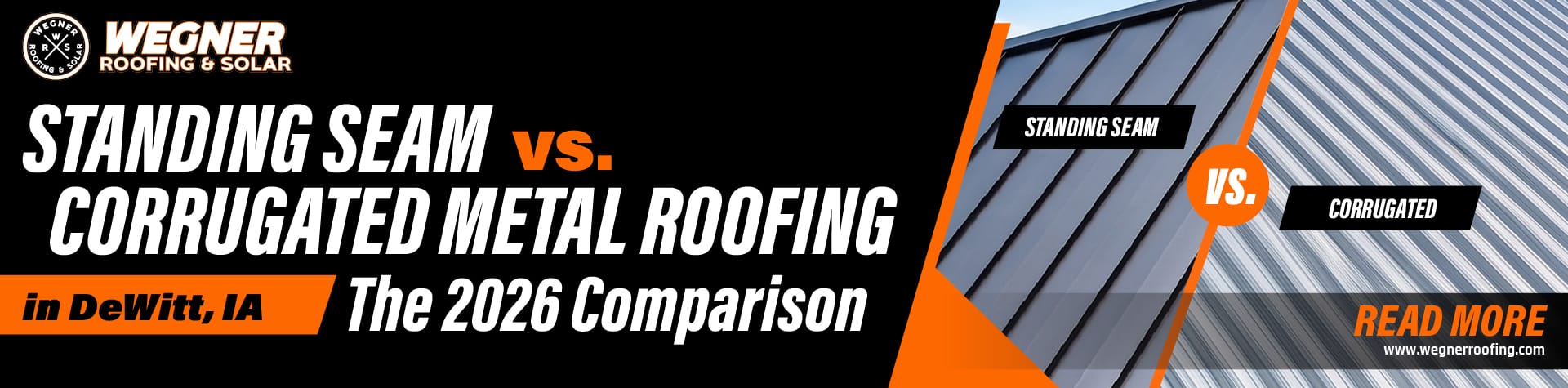
Standing Seam vs. Corrugated: Which Metal Roof Actually Survives Iowa Weather?
When DeWitt homeowners ask us about standing seam vs corrugated metal roof options, the conversation always lands on one mechanical detail: where the fasteners live. Standing seam tucks its clips underneath a raised seam, so no screw ever punctures the panel face. Corrugated, sold locally under names like 5V-crimp or R-panel, takes the opposite approach, driving exposed screws straight through the metal, each one sealed with a rubber washer that wears out over time.
That single design difference is the root cause behind nearly every other variable you’ll weigh in this decision: installed cost, expected lifespan, hail resistance, and how the roof holds up when a straight-line wind event rolls through Clinton County. Below is the short answer, followed by the mechanical reasoning that explains why it plays out that way.
Not sure which system fits your roof? Get an on-site evaluation from our DeWitt metal roofing team, and we’ll walk you through both options based on your actual property, not a generic estimate.
Standing Seam vs. Corrugated Metal Roof: Side-by-Side Comparison for DeWitt, IA
Attribute | Standing Seam | Corrugated (Exposed Fastener) |
Fastening method | Concealed clips under mechanical seam | Exposed screws through panel face, rubber washer seal |
Typical panel gauge (Iowa market) | 24 gauge steel | 26 to 29 gauge steel |
Installed cost, DeWitt, 2026 | $9 to $16 per sq ft | $4 to $8 per sq ft |
Functional lifespan | 40 to 70 years | 20 to 30 years (fastener-limited) |
Hail impact rating | UL 2218 Class 4 available on stone-coated and textured finishes | Typically Class 3, occasionally Class 4 on heavier gauges |
Wind uplift performance | Rated to 140 to 160+ mph with proper clip spacing | 90 to 120 mph, drops as washers age |
Best fit in DeWitt | Primary residences, homes near downtown and historic districts | Pole barns, machine sheds, ag outbuildings near Grand Mound and Low Moor |
Re-fastening maintenance | None required | Every 12 to 15 years as washers UV-degrade |
If you want the roof to outlast your mortgage with zero maintenance, standing seam wins. If you’re roofing a machine shed near Welton and budget is the deciding factor, corrugated does the job at roughly half the installed cost. When you are ready to get accurate numbers for your specific property, the roofing contractors in DeWitt, Iowa, at Wegner Roofing & Solar can walk you through both options during an on-site evaluation.
What Actually Separates These Two Panel Systems
Concealed Fasteners vs. Exposed Fasteners
A standing seam panel snaps or mechanically seams into its neighbor, and a hidden clip anchors it to the deck. Nothing penetrates the metal surface itself. That matters in Iowa because DeWitt sees roughly a 100-degree annual temperature swing, from sub-zero January mornings to 90-plus-degree July afternoons. Metal expands and contracts with every swing, and a concealed-clip system is engineered to float slightly as the panel moves. An exposed-fastener corrugated panel can’t float. The screw holds the metal rigid at that point, and thousands of expansion cycles eventually work the hole slightly larger. That’s not a defect. It’s just physics, and it’s the reason exposed-fastener systems need periodic re-torquing or re-gasketing.
Panel Gauges and Coatings Sold Locally
In the DeWitt market, standing seam is almost always installed in 24-gauge steel with a Kynar 500 or similar PVDF finish, which resists chalking and fading for 30-plus years. Corrugated panels run lighter, typically 26 to 29 gauge, which is why they cost less but also dent more readily under impact. Some corrugated products are available in 24-gauge for agricultural applications, closing part of the durability gap, but that upgrade narrows the price advantage.
Hail Performance for Clinton County Roofs
Denting Thresholds and UL 2218 Class 4 Ratings
UL 2218 tests a roofing product by dropping a 2-inch steel ball from increasing heights and checking for cracking or splitting (not just cosmetic denting). Class 4, the highest rating, means the panel resisted a ball dropped from 20 feet without fracturing. Many stone-coated or textured standing seam products carry this rating. Standard smooth corrugated panels usually test to Class 3, meaning they can dent visibly under large hail without failing structurally. For insurance purposes, a Class 4 roof can qualify for a premium discount in Iowa, something worth asking your carrier about directly. If severe weather strikes Clinton County and you’re left wondering does insurance cover roof replacement, coverage often hinges on whether the hail caused structural compromise or merely cosmetic panel denting.
What the 2020 Derecho Taught Local Contractors
On August 10, 2020, a derecho tracked across Iowa with gusts documented over 100 mph through the Cedar Rapids-Iowa City corridor and into the Quad Cities area, just south of Clinton County. It remains one of the costliest thunderstorm events in U.S. history, with insured losses exceeding $11 billion regionally. We inspected dozens of roofs in the derecho’s wider path afterward, and the pattern was consistent: exposed-fastener panels lost screws at the ridge and eave first, where wind uplift concentrates, while standing seam systems with proper clip spacing stayed fully attached even where surrounding tree damage was severe. That’s not a knock on corrugated roofing generally. It’s a specific lesson about fastener exposure under sustained straight-line wind, and it’s why we spec tighter clip intervals on any standing seam job near the US-30/US-61 corridor.
Wind Performance on the DeWitt Corridor
Design Wind Speeds for This Area
DeWitt falls under Iowa’s adopted IRC/ASCE 7 wind provisions, which place most of eastern Iowa in a 105 to 115 mph ultimate design wind speed zone for Risk Category II structures. That’s the baseline your roofing system needs to meet on paper. Properly clipped standing seam panels are rated well above that threshold, often to 140 mph or higher. Exposed-fastener corrugated panels meet code when installed correctly, but their real-world margin above that 105 to 115 mph baseline is thinner, especially as washers age past year 12 or 15.
Why Exposed Fasteners Loosen Faster in Sustained Wind
Wind uplift doesn’t just pull straight up. It creates a repetitive flutter at panel edges during sustained gusts, and every flutter cycle works slightly against a screw hole. A concealed clip distributes that same load across a continuous seam rather than a single puncture point. This is the mechanical reason corrugated roofs are far more common on outbuildings than on primary residences in wind-exposed markets like ours.
2026 Cost Comparison: Standing Seam vs. Corrugated in DeWitt
Installed Cost Per Square Foot
Standing seam runs $9 to $16 per square foot installed in the DeWitt market as of 2026, depending on gauge, finish, and roof complexity. Corrugated runs $4 to $8 per square foot installed. On an average 2,000-square-foot DeWitt roof, that’s roughly a $10,000 to $16,000 gap between systems, a real number that drives a lot of these decisions.
30-Year Total Cost of Ownership
Here’s where the math flips for some homeowners. A corrugated roof will likely need re-fastening or gasket replacement around year 12 to 15, at a cost that can run several thousand dollars depending on roof size, plus it will likely need full replacement again before the standing seam roof needs anything. Run the numbers over 30 years and standing seam frequently comes out ahead or roughly even on total cost, even though the upfront number is higher. For a machine shed you’re not planning to keep for 30 years, corrugated’s lower upfront cost usually still wins.
Lifespan in Iowa's Freeze-Thaw Climate
Thermal Expansion Across DeWitt's Seasonal Swings
Steel expands and contracts roughly 1/8 inch per 10 linear feet across a 100-degree temperature swing. Standing seam clips are engineered to accommodate that movement indefinitely. Exposed screws are not, which is the core reason standing seam is rated for 40 to 70 years of service while corrugated is generally rated for 20 to 30 years before major maintenance or replacement.
The Fastener Inspection Schedule Corrugated Roofs Actually Need
If you go with corrugated, plan on a visual fastener inspection every 5 years starting around year 10, and budget for a full re-gasketing pass around year 12 to 15. Skipping this is the single most common cause of corrugated roof leaks we see on service calls in Clinton County, and it’s almost always preventable with a scheduled check.

Which Panel Fits Your DeWitt Property
Homes Near Downtown DeWitt and 6th Avenue
For the historic and established residential streets around downtown DeWitt and 6th Avenue, standing seam is almost always the better long-term investment. These are primary residences where curb appeal, resale value, and zero-maintenance performance matter more than shaving a few thousand dollars off the upfront bid.
Rural Properties and Outbuildings Near Grand Mound, Welton, and Low Moor
For the machine sheds, pole barns, and ag outbuildings common on properties around Grand Mound, Welton, and Low Moor, corrugated remains the practical standard. It’s cost-effective, easy to source in long runs, and perfectly adequate for structures where the maintenance schedule is manageable, and aesthetics are secondary.
A quick example: A homeowner near Grand Mound recently called us about a 30-year-old corrugated roof on their house that was leaking at nearly every fastener line. As a roofing contractor in Dewitt, IA, we walked them through both options, and given they planned to stay in the home long-term, they chose to upgrade to a 24-gauge standing seam system rather than repeat the corrugated cycle. Their machine shed 200 feet away, built the same year, still had a serviceable corrugated roof with two prior re-gasketing passes. Same property, two different service lives, because the fastener system matched the building’s use case each time.
Which One Should You Choose?
Choosing the right metal panel system is rarely a one-size-fits-all answer; it depends entirely on your budget, property goals, and local weather exposure. To ensure you make the most cost-effective choice for your specific situation, weigh these four key factors before signing a contract:
- Ask how long you’re keeping the property. Under 10 years, corrugated’s lower cost usually wins on a secondary structure. Long-term primary residence: standing seam pays for itself.
- Check your wind and hail exposure. If you’re in an open, wind-exposed lot near the US-30/US-61 corridor, prioritize the concealed-fastener system.
- Factor in insurance discounts. A UL 2218 Class 4 standing seam roof may reduce your premium; ask your carrier before you finalize a bid.
- Get both bids priced apart. A contractor who separates these two systems clearly on your estimate, rather than bundling vague “metal roofing” line items, is giving you the transparency you need to compare.
If you’re still deciding between the two, our roofing contractors can walk your specific roof and give you a straight recommendation based on your building’s exposure, not a one-size-fits-all pitch. For homeowners weighing whether metal makes sense at all against asphalt, our Is a Metal Roof Worth It in DeWitt, IA breakdown covers that decision in more depth, and our Best Roofing Materials for High Wind in DeWitt, IA guide compares metal against every other wind-rated option on the market. If hail is your bigger concern than wind, our impact resistant roofing page details Class 4 options across every material type, not just metal.
Frequently Asked Questions
What is the difference between standing seam and corrugated metal roofing?
Standing seam uses concealed clips under a raised seam so no fastener touches the panel face, while corrugated uses exposed screws with rubber washers driven directly through the metal. This one difference drives the gap in cost, lifespan, and wind performance between the two systems.
Which metal roof panel handles Iowa hail better?
Standing seam generally performs better in hail, with many stone-coated products earning a UL 2218 Class 4 rating. Standard corrugated panels typically test to Class 3, meaning they’re more prone to visible denting under large hail even though they rarely fail structurally.
How much more does standing seam cost?
Standing seam installs for $9 to $16 per square foot in the DeWitt market versus $4 to $8 for corrugated, roughly double. On a 2,000-square-foot roof, expect a $10,000 to $16,000 gap, though standing seam often wins on 30-year total cost.
Do metal roofs need special fasteners in high wind?
Yes. Standing seam relies on properly spaced concealed clips rated up to 140 mph or higher, while exposed-fastener corrugated systems need correct screw spacing and periodic re-torquing to maintain their 90 to 120 mph rating as gaskets age.
How long does a metal roof last in Iowa?
Standing seam typically lasts 40 to 70 years in Iowa’s freeze-thaw climate because concealed clips accommodate thermal movement. Corrugated systems generally last 20 to 30 years before fastener and gasket wear requires re-fastening or full replacement.
Your Roof, Your Investment: Making the Right Choice in DeWitt
When weighing a standing seam vs corrugated metal roof in DeWitt, the right choice comes down to your budget and how long you plan to own the property. Both systems serve a purpose. Corrugated panels remain the cost-effective champion for agricultural outbuildings and short-term investments, while standing seam provides unmatched, maintenance-free longevity for primary residences facing harsh Iowa weather.
Don’t guess which panel system makes sense for your home. At Wegner Roofing & Solar, we’ve been protecting Clinton County families since 2011 with straightforward, no-upsell guidance. Call our local team now to schedule a roof evaluation.
Get Your Free Estimate
