- Family owned since 2011
Sagging Roof in DeWitt, IA: Causes, Signs & Fixes
2,000+
Five-Star Reviews
5,000+
Projects Completed
15 Years
In Business
24/7
Emergency Response
Spotting a Sagging Roof in DeWitt, IA: Warning Signs, Structural Fixes, and What to Do Next
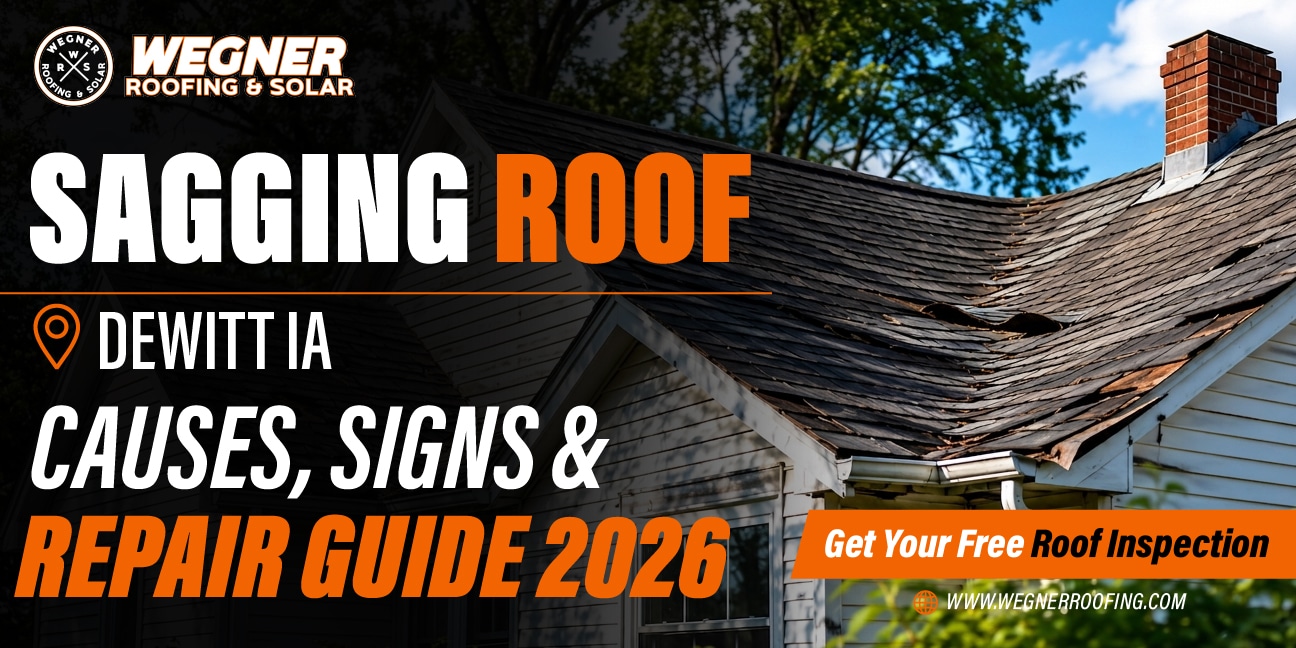
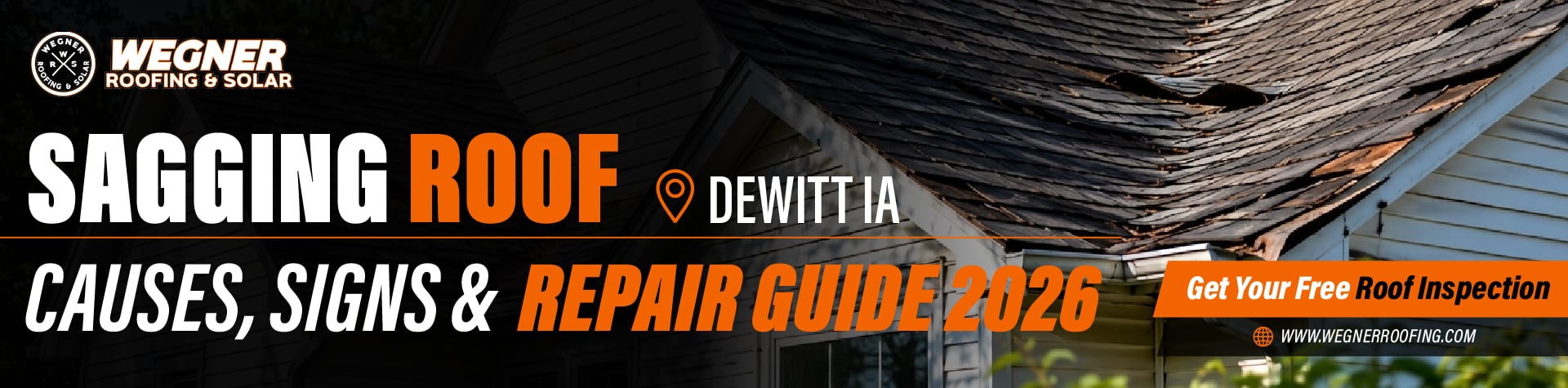
A sagging roof is technically defined as a rafter or truss system that has deflected beyond building code allowances (typically more than L/240 of the span for ceilings supporting drywall). On a standard roof with 16 feet of unsupported rafter length, that translates to roughly 0.8 inches of dip before it is officially out of compliance. In plain terms: if you can clearly see a dip, wave, or low spot while standing across the street from your DeWitt home, your roof has likely already crossed that line.
This is never just a cosmetic quirk. A bowed ridge or dipping rafter line is an early warning that the framing beneath your shingles is losing its ability to support its own weight, let alone heavy Iowa winter snow and severe wind gusts. Below, we break down what causes structural deflection in Clinton County homes, how to tell if you need a targeted repair or a full replacement, and what steps you should take next.
Worried about a dip in your roofline? Do not wait for the next winter freeze or heavy storm to test your home’s structural framing. Call our local DeWitt team at (563) 214-1558 or schedule your 100% transparent roof inspection today to get honest answers with zero sales pressure.
What "Sagging" Actually Means, Structurally
There are two different things homeowners call “sagging,” and they’re not the same problem:
- Ridge sag – the peak of the roof dips in the middle, usually a sign the ridge board or ridge beam has failed or was undersized when the home was built.
- Rafter/decking sag – individual sections between the ridge and eaves show a wave pattern, usually pointing to rotted decking, an overloaded rafter, or water-saturated insulation pressing down from below.
Both are structural, not aesthetic. Neither resolves on its own, and both get more expensive to fix the longer they’re left alone.

7 Warning Signs Your DeWitt Roof Is Sagging
Most homeowners don’t spot sagging from inside the house first. Here’s the order signs typically appear, based on the failure patterns we see across Clinton County:
1. A visible dip along the ridge line, best seen standing across the street, not directly underneath.
2. Wavy or uneven shingle rows, a flat plane should reflect light evenly; a sagging deck creates visible shadow lines.
3. Interior ceiling cracks, especially where an interior wall meets the ceiling, a sign the load path has shifted.
4. Doors and windows on the top floor sticking, framing racking under an uneven roof load changes door and window squareness.
5. A “trampoline” feels underfoot in the attic, decking that flexes noticeably when walked on has already lost stiffness.
6. Daylight or gaps at the ridge vent, separation here means the ridge board has physically moved.
7. Sagging gutters pulling away from the fascia, often a secondary symptom of the same structural shift affecting the roofline above it.
If you’re seeing two or more of these, skip the guesswork. A roof inspection from a licensed roofing contractor in Dewitt, IA will confirm what’s actually happening above your ceiling.
What Causes a Sagging Roof in Clinton County Homes
Sagging isn’t random. In DeWitt, four causes account for the vast majority of the calls we get.
1. Snow Load Exceeding the Roof's Design Capacity
The Iowa Residential Code assigns Clinton County a ground snow load design value in the 20-25 pound-per-square-foot range under Figure R301.2(5). A wet, heavy snowpack, especially the kind that sits through a slow February thaw-and-refreeze cycle, can exceed that design value on an older roof that was framed before current code updates or has already lost some structural capacity to age or moisture. The result is exactly the kind of mid-span sag described above, appearing gradually over a single hard winter.
2. Straight-Line Wind and Derecho Damage
Clinton County isn’t a stranger to catastrophic wind events. The August 10, 2020 derecho produced a measured 130 mph wind gust two miles northeast of Clinton, Iowa, less than 20 miles from DeWitt, and tracked straight-line winds in the 100-130 mph range across the county. Wind at that force doesn’t always tear a roof apart outright; it can rack the truss system, crack fastener connections, and leave a roof structurally weakened in a way that only shows up as a slow sag months or years later, especially the next time meaningful snow load stacks on top of it.
3. Decking and Rafter Rot from Trapped Moisture
DeWitt sits in a freeze-thaw climate zone. Water that gets past aging flashing or a worn pipe boot doesn’t just stain a ceiling, it soaks into roof decking and rafters. Wet lumber loses a significant percentage of its load-bearing strength, and repeated freeze-thaw cycling accelerates the rot. A rafter that’s been quietly absorbing moisture for three or four winters can fail well before its expected lifespan, sagging under a load it would have easily carried when dry.
4. Original Undersized Framing
DeWitt’s housing stock includes a meaningful share of homes built before modern span tables were standard, particularly in the blocks near the historic downtown square and the DeWitt Opera House district. Some of these homes were framed with 2×6 rafters on spans that today’s code would require a 2×8 or engineered truss to handle. These roofs can sag for no reason other than age catching up to a framing decision made decades ago.
Where Sagging Shows Up First in DeWitt Homes
Location matters here, and it’s not a generic statement. Homes built before the 1970s near the downtown square and 6th/7th Avenue corridor more often show ridge sag tied to original framing decisions, since that housing stock predates current span-table requirements.
Meanwhile, newer construction along the US-30 and US-61 corridor, where DeWitt’s fastest growth has occurred over the past 15 years, tends to show storm-related sagging tied to the 2020 derecho’s wind path or subsequent hail events rather than age.If your home sits within a mile of either corridor, that context helps our team, as a trusted roofing contractor in DeWitt, IA, know exactly what to check first.
Is It Repairable, or Do You Need a Full Roof Replacement?
Not every sagging roof needs a full roof replacement. The deciding factor is whether the damage is isolated to a section that can be sistered, reinforced, or rebuilt, or whether the sag reflects a system-wide capacity problem.
Factor | Repair Likely Sufficient | Replacement Likely Needed |
Sag location | One localized section (e.g., over a single room addition) | Runs the full length of the ridge or multiple rafters |
Roof age | Under 15 years | 20+ years, nearing or past the shingle’s rated life |
Decking condition | Firm, no spongy spots when walked | Soft, spongy, or visibly rotted decking |
Cause | Isolated leak or single storm event | Chronic moisture exposure or repeated storm damage |
Interior symptoms | Minor, one ceiling crack | Multiple cracks, sticking doors, visible daylight at ridge |
A licensed inspector needs to physically check rafter condition, decking firmness, and moisture content before this decision is final; a photo from the ground can’t confirm it. If your situation matches the right column, our roof replacement page covers the full tear-off process, materials, insurance and $0-down financing options available for Clinton County homeowners. If it matches the left column, our roof repair page walks through what a targeted structural fix involves.
What Happens If You Ignore a Sagging Roof
Here’s a realistic scenario we’ve seen play out locally: a DeWitt homeowner near the US-61 corridor noticed a minor ridge dip after a heavy 2023 snow season but decided to wait until spring. By the following winter, the same section had progressed from a half-inch dip to over two inches, moisture had worked into the decking through stress cracks in the shingles above the sag, and what would have been a 2,000 to 4,000 localized rafter repair became a full section tear-off with decking replacement, closer to the cost of a partial re-roof. The physics don’t reverse themselves; a sagging structural member keeps deflecting under repeated load cycles, and the shingles above a sag crack and fail faster because they’re no longer lying flat.
The Wegner Sagging Roof Inspection Process
When you call about a sagging roof, here’s what actually happens, not a sales pitch, a diagnostic process:
- Attic and rafter check (10 to 15 minutes). We measure deflection, check for daylight gaps at the ridge, and test decking firmness by walking the attic floor.
- Exterior roof walk (15 to 20 minutes). We check for shingle cracking above the sagging area, ridge vent separation, and flashing condition around the affected section.
- Moisture and rot assessment. Any suspect decking or rafter gets a moisture-meter check to confirm whether rot has already set in.
- Written findings with photos. You get a plain-English report, not jargon, showing exactly what we found and where.
- Honest recommendation. Repair or replace, based on the table above, not on what pads a quote.
This entire process is covered under our roof inspection offer for DeWitt homeowners. No cost, no obligation to book anything afterward. To see exactly how long the rest of the project takes, check out our full guide: Roof Replacement Timeline in DeWitt, IA: How Long From Estimate to New Roof.
What Drives the Cost of Fixing a Sagging Roof
Three variables move the price more than anything else: how many rafters or truss members are affected, whether decking replacement is needed alongside the structural fix, and roof accessibility (a steep multi-story roofline near the downtown square takes longer to stage safely than a single-story ranch off Highway 61). Because sagging repairs vary so widely by scope, we don’t quote a number sight unseen; every estimate follows a physical inspection so you get a firm, itemized figure instead of a guess that changes once we’re on the roof.
Storm and Insurance: When Does a Sagging Roof Qualify as a Claim?
If your sag traces back to a specific wind or hail event, like derecho-force gusts racking your truss connections, it may be covered under your homeowner’s policy as sudden storm damage, subject to your deductible and policy language. Gradual sag from age or slow moisture intrusion is typically treated as a maintenance issue and is less likely to be covered.
Our storm damage restoration team documents the connection between a specific storm date and the resulting structural damage, which is exactly the kind of evidence an adjuster needs to evaluate a claim fairly. We’re not a public adjuster and can’t guarantee an outcome, but we can make sure the documentation doesn’t fall short.
Frequently Asked Questions
Is a sagging roof always an emergency?
No, not always, but it should never be ignored. A sagging roof needs a professional inspection within days, not months, because deflection tends to worsen under the next snow or wind load, turning a minor repair into a major one.
Can a sagging roof collapse?
Yes, in severe cases. A roof that has lost significant load capacity, especially one with rotted decking or snapped rafter connections, can fail suddenly under added snow weight. Most sagging roofs don’t reach this point if addressed early, which is why prompt inspection matters.
How much does it cost to fix a sagging roof rafter?
Cost depends on how many rafters are affected, whether decking needs replacing, and roof accessibility, so pricing varies significantly by home. A free on-site inspection gives you a firm, written number instead of a rough estimate.
Will homeowner's insurance cover a sagging roof?
Sometimes, if the sag is tied to a specific storm event like high wind or hail. Gradual sagging from age or moisture is usually considered a maintenance issue, not a covered loss. Documentation from a professional inspection helps clarify which category applies.
Can I just add support beams instead of replacing the roof?
Sometimes, if the sag is isolated and the surrounding structure is sound, sistering or adding support can resolve it without a full replacement. This only works when decking and rafters elsewhere are still structurally healthy, which is why an inspection has to confirm it first.
Take the Guesswork Out of Your Roof's Structural Health
A sagging roof is a clear signal that your home needs professional attention, and structural deflection simply will not fix itself. Hoping the problem stays the same over another harsh Iowa winter is a risk that almost always leads to more costly damage. Guessing about the safety of your home costs far more than verifying it. Since 2011, the dedicated team at Wegner Roofing & Solar has been expertly diagnosing framing issues across DeWitt and Clinton County. Our local crew has the deep technical knowledge to evaluate your specific situation accurately. Within just an hour, we can tell you exactly whether you are looking at a simple isolated rafter repair or if a larger replacement is necessary.
You deserve absolute peace of mind when it comes to the roof over your head. Schedule your roof inspection with Wegner Roofing & Solar today, and see why DeWitt homeowners keep leaving us five-star reviews on Google.
Get Your Free Estimate