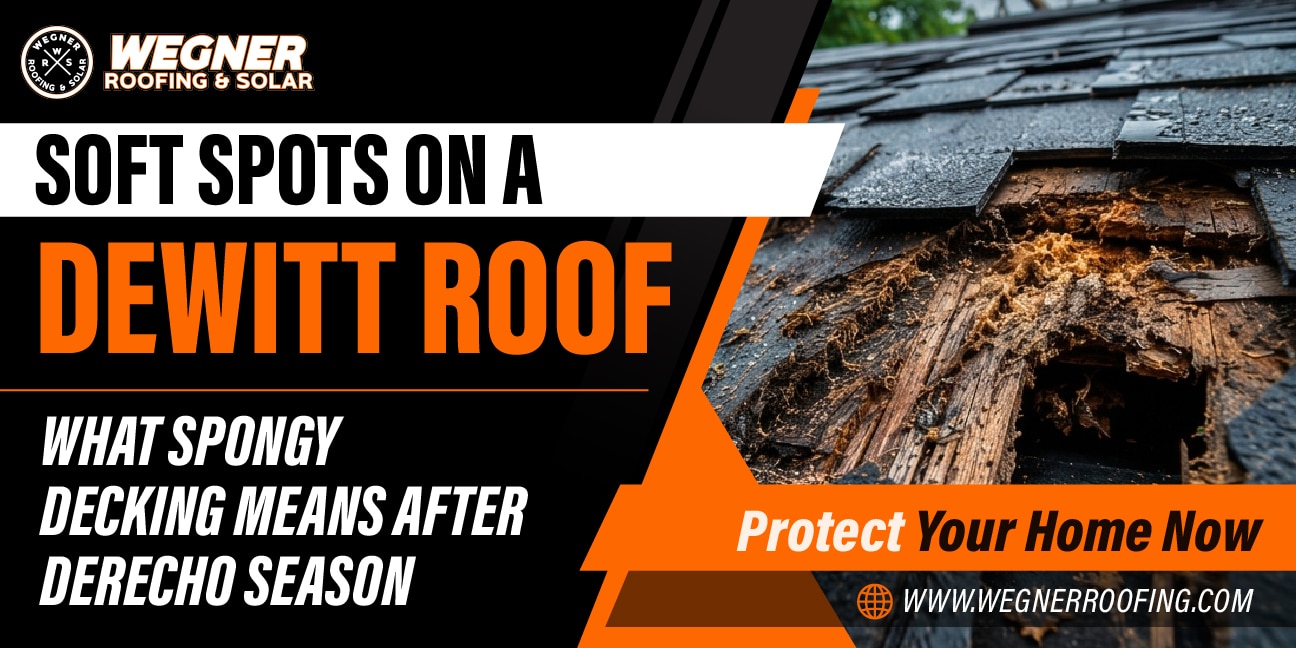
Soft Spots on a DeWitt Roof: What Spongy Decking Means After Derecho Season
Table of Contents
DeWitt’s 2026 derecho season pushed straight-line winds through the Highway 30 corridor and rattled roofs from Lincoln Park to the subdivisions near Central DeWitt Community Schools.
If you climbed into your attic afterward and felt give underfoot, you’re not imagining it.
Roof soft spots form when wind-driven rain works past a lifted shingle and slowly saturates the plywood or OSB decking below.
The good news: catching this early usually means a targeted repair instead of a full rebuild.
The bad news: roof soft spots left through even one Iowa winter tend to spread fast once freeze-thaw cycles get involved.
Here’s what’s actually happening under your shingles and what it means for your DeWitt home
Why DeWitt Roofs Develop Soft Spots After Derecho Season
Straight-line winds during derecho events lift shingle edges just enough to break the seal without tearing the shingle off completely.
Water then wicks sideways under the mat every time it rains.
Common causes we see across Clinton County after storm season include:
- Lifted or cracked shingle tabs from sustained straight-line wind pressure.
- Failed flashing around valleys, chimneys, and pipe boots.
- Clogged or damaged gutters that push water back under the roof edge.
- Ice dam backup from the previous winter that never fully dried out.
- Aging underlayment that’s lost its ability to shed water once shingles fail.
Roof soft spots rarely start from one dramatic event.
They build over a season of small intrusions that never got documented or repaired.
What That Spongy Feel Actually Means
When you walk your attic joists or step near a valley and feel a bounce instead of solid resistance, you’ve found trapped moisture under shingles that has already begun breaking down the wood’s structural fibers.
Saturated OSB decking loses a significant amount of its load capacity compared to dry wood.
This loss of structural integrity is the physical cause behind every single roof soft spot DeWitt homeowners report after a wet storm season.
Deck Deflection Between Trusses: Reading the Warning Signs
Not every soft spot means the whole roof is failing. Isolated deck deflection between trusses usually points to a localized leak rather than a system-wide failure.
Signs that help tell the difference:
- Small, single-bay bounce near one valley or penetration: Often indicates an isolated repair.
- Bounce spanning multiple rafter bays: Likely points to a bigger moisture problem underneath.
- Discoloration on the underside of the decking: Confirms active or past water intrusion.
- Musty attic smell: Suggests moisture has been trapped longer than it looks.
This distinction matters because it changes your repair scope for any roof soft spots found on your property.

Is It Safe to Walk on a Roof With Soft Spots?
Short answer: no, not without support. “Is it safe to walk on flexing decking?” is one of the most common questions we get from DeWitt homeowners trying to inspect their own roofs.
A foot placed on rotted OSB can punch straight through, sending you into the attic insulation or worse.
If you suspect roof soft spots anywhere on your home, stay off the roof and call a licensed contractor who carries fall protection and knows where the trusses actually sit.
Ready to find out how far the damage has spread before you climb another ladder? Book a professional roof inspection and get a written report with photos, no obligation attached.
How Pros Confirm a Soft Spot Before Cutting Into Your Roof
A visual bounce test tells us where to look, but a moisture meter roof reading tells us how bad it actually is.
Pin-style meters read moisture content directly from the decking, giving us a number instead of a guess.
What a professional inspection typically documents:
- Moisture percentage at multiple points across the affected area.
- Photos of the underside decking where accessible from the attic.
- Extent mapping showing how far the soft area spreads across rafter bays.
- Likely entry point where water is getting past the shingle line.
This reading also becomes documentation.
If a covered storm peril, like a derecho, caused your roof soft spots, a dated moisture reading paired with photos strengthens your position with an insurance adjuster far more than a verbal description ever could.
What Drives Soft Spot Repair Cost in DeWitt
Soft spot repair cost in Clinton County isn’t a flat number; it depends on how far the damage has spread and what’s needed to fix it properly.
The main factors include:
- Number of rafter bays affected: One soft spot vs. several changes the scope significantly.
- Whether trusses need sistering: Reinforcing weakened structural members adds labor.
- Shingle field disruption: How much surrounding roofing has to come up to reach the deck.
- Decking material replacement: New plywood or OSB, underlayment, and flashing tie-in.
Homeowners sometimes ask whether roof soft spots qualify for a full roof replacement instead of a patch.
If the rot traces back to a storm event and spans a large percentage of one slope, replacing the whole section is often the smarter long-term call than chasing repairs one bay at a time.
Ceiling Stain Below Soft Spot: The Sign Inside Your Home
A ceiling stain below a soft spot location is often the first clue homeowners notice, sometimes months before anyone climbs into the attic.
Brown rings on drywall mean water has already traveled through the decking, underlayment, and insulation to reach your living space.
Watch for these interior warning signs alongside the stain:
- Peeling paint or bubbling drywall near the stain’s edge.
- A musty odor in the room directly below the affected roof section.
- Stain growth after each new rainfall, even a light one.
By the time that stain appears, the roof soft spots causing it have usually been active for a full season or longer.
If a storm caused this damage, your policy may cover more than you’d expect.
Read our full DeWitt, IA Roof Insurance Coverage Guide before you file, and don’t wait until the stain spreads to call it in.
Key Takeaways
Roof soft spots form when trapped moisture under shingles saturates the decking, weakening its ability to hold weight.
A spongy feel underfoot signals active rot, not just cosmetic wear, and often traces back to derecho or hail damage.
Isolated deck deflection between trusses is repairable; widespread softness across multiple bays usually points to replacement.
Never test roof soft spots by walking on them; call a professional with fall protection instead.
A moisture meter roof reading and dated photos give you real documentation, which matters if you’re filing an insurance claim.
Soft spot repair cost depends on how many bays are affected and whether structural sistering is needed.
Don't Let Winter Finish What Derecho Season Started
Every week a soft spot sits untreated in DeWitt, the rot spreads a little further into surrounding decking, and the repair scope grows with it.
Iowa’s freeze-thaw cycle doesn’t pause for procrastination; it accelerates the damage every time water refreezes in that softened wood.
The homeowners who catch roof soft spots early, before the first hard freeze locks moisture into the deck, are the ones who avoid the most extensive repairs come spring.
Wegner Roofing & Solar has been climbing DeWitt roofs since 2011, and we know exactly where derecho winds tend to lift shingles first.
Contact Wegner Roofing & Solar today for a free, no-obligation inspection before winter traps this damage in place for good.
Want to see our track record with DeWitt homeowners? Check out our Google Business Profile reviews before you decide who climbs your roof next.

FAQs About Spongy Roofs and Derecho Damage
Why does part of my DeWitt roof feel spongy underfoot?
A spongy feel means water has soaked into the decking beneath your shingles, usually from a lifted shingle edge or failed flashing during a windstorm.
The wood fiber softens as moisture content rises, reducing its ability to hold weight safely.
Does a soft spot always mean the decking is rotted?
Not always immediately, but untreated moisture leads to rot quickly in Iowa’s freeze-thaw climate.
Early softness may still be reversible with a targeted repair; a delayed response almost always results in structural decking rot.
How urgent is a soft spot before winter?
Very urgent. Freezing temperatures cause trapped moisture to expand inside the decking, rapidly accelerating wood rot with every freeze-thaw cycle.
Scheduling an inspection before the first hard freeze can mean the difference between a small patch and a full deck rebuild.
Table of Contents
Drip Edge Installed Wrong on a DeWitt Roof? Signs, Damage, and Fixes Table of Contents DeWitt sits between the Wapsipinicon and Mississippi River valleys, where
Soft Spots on a DeWitt Roof: What Spongy Decking Means After Derecho Season Table of Contents DeWitt’s 2026 derecho season pushed straight-line winds through the
Loose Shingles After a DeWitt Windstorm: Why They Lift and What Repair Costs Table of Contents A gust rolls off the fields along Lincoln Highway
Rotted Roof Decking in DeWitt: How to Spot It and When It Must Be Replaced Table of Contents DeWitt sits close enough to the Mississippi
Zero-Down Roof Replacement in DeWitt, IA: How Eastern Iowa Homeowners Finance With No Out-of-Pocket Table of Contents DeWitt homeowners got a hard lesson in storm