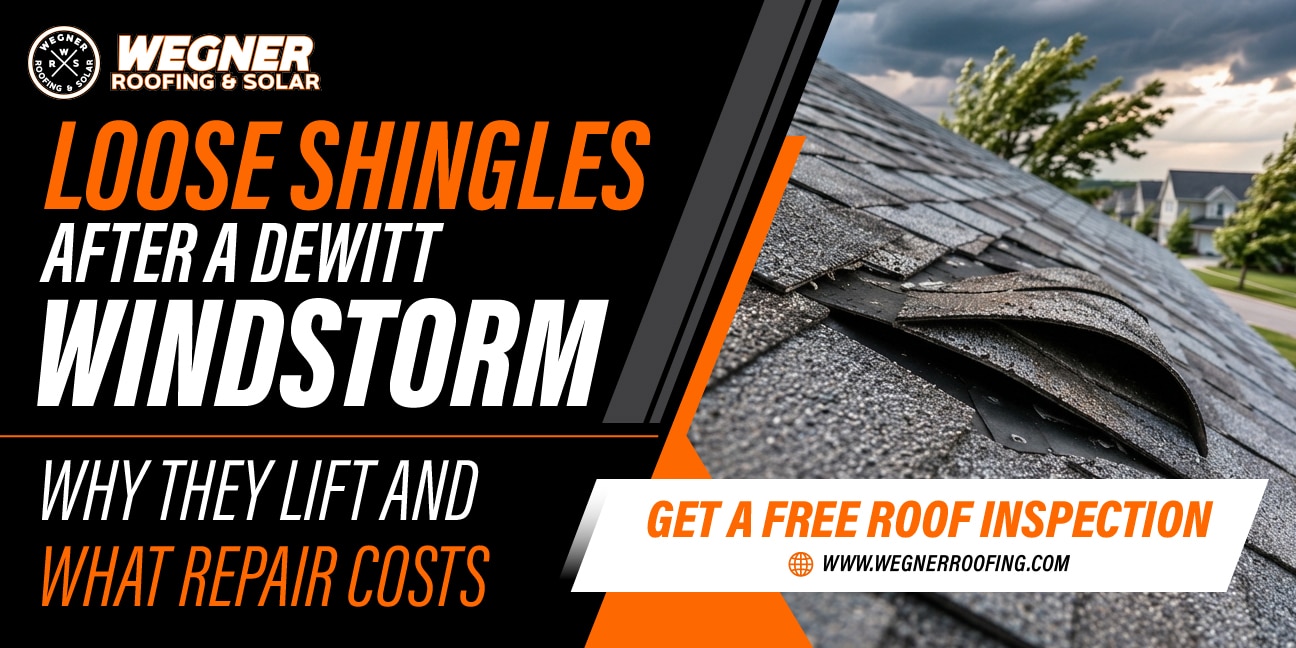
Loose Shingles After a DeWitt Windstorm: Why They Lift and What Repair Costs
Table of Contents
A gust rolls off the fields along Lincoln Highway and straight into DeWitt at 50 to 55 mph, and within minutes you’ve got loose shingles flapping along your ridge line.
That’s not rare here; Clinton County sees wind events strong enough to lift shingles nailed even slightly below manufacturer spec several times a year.
If you’re staring up at loose shingles right now, expect a straightforward spot repair to run $250-$650 in most cases, with a full slope replacement climbing higher if the damage is widespread.
Loose shingles rarely mean your whole roof is failing.
But they also don’t fix themselves, and every week you wait is another week wind, rain, and UV exposure work on the exposed decking underneath.
What Causes Loose Shingles on a DeWitt Roof?
Shingles stay flat because of a factory-applied adhesive strip that bonds to the course below once it’s warmed by sun exposure.
When that bond fails from age, cold installation, or repeated wind flex, you get loose shingles that lift with every gust.
Installers sometimes call this shingle sealant strip failure, and it’s one of the most common reasons DeWitt homes develop loose shingles years before the roof’s expected lifespan ends.
The other frequent culprit is fastening. Nails backing out of decking happens when shingles were nailed too high on the tab or driven at an angle, a defect roofers refer to as high nail placement.
Over several freeze-thaw cycles, and Clinton County regularly swings 27°F to 38°F in a single February day, those nails work loose, and the shingle above them starts to flap.
The two most common triggers behind loose shingles in DeWitt:
- Sealant strip failure: The adhesive bond between shingle courses breaks down from age, sun exposure, or being installed in cold weather.
- High nail placement: Nails driven above the manufacturer’s designated zone lose grip faster and back out during freeze-thaw cycling.
Spotting Loose Shingles Before They Become a Bigger Problem
Loose shingles are easiest to catch from the ground, right after a wind event.
- Look for lifted edges or corners along ridges and roof edges, where wind pressure is strongest.
- Notice shingles that look “off-pattern” compared to the row above or below.
- Check for granules collecting in the gutters near the suspected area.
- Listen for tapping or flapping sounds during windy nights.
If you spot any of these, a same-day call is worth it.
Our team handles fast roof repair for exactly this kind of damage before loose shingles turn into an open deck and an interior leak.

Ready to get ahead of it? Contact Wegner Roofing & Solar for a free inspection before the next DeWitt wind event finishes the job.
Resealing vs. Replacing: What Actually Fixes Loose Shingles
Not every lifted shingle needs a full swap. If the shingle itself is intact, with no cracks and no torn tabs, a roofer can often press it back down and apply a compatible roofing cement to restore the seal.
This works well when loose shingles are isolated to a few spots and the mat underneath hasn’t been damaged by UV exposure.
Spot repair vs. slope replacement becomes the real decision point when loose shingles show up across an entire roof plane rather than in a cluster.
Wind that lifts one shingle usually stresses its neighbors too, even if they haven’t visibly popped yet.
A DeWitt roofer worth hiring will check adjacent shingles for cracked sealant strips before calling it a simple patch job.
Resealing lifted shingles is the right call when:
- The shingle is crack-free with no torn tabs or missing granules.
- Loose shingles are limited to a small, isolated cluster.
- The roof deck underneath shows no visible water staining.
Full replacement is usually the better move when:
- Loose shingles are scattered across most of a slope.
- Adjacent shingles show cracked or brittle sealant strips.
- The roof is already 15+ years old and nearing the end of its life.
What Determines Shingle Blow-Off Repair Cost in DeWitt
Shingle blow-off repair cost in eastern Iowa depends on four things: how many shingles are loose, how steep and accessible the roof is, whether the shingle color and profile need matching, and whether it’s an after-hours emergency call.
A single loose shingle on a walkable roof might run under $250.
A cluster spread across a high-pitch section with hard-to-match architectural shingles can run several hundred more.
The main cost drivers homeowners should expect:
- Number of loose shingles: A handful is far cheaper than a full slope’s worth.
- Roof pitch and access: Steep or multi-story roofs require more safety equipment and time.
- Material matching: Discontinued colors or profiles can add cost and delay.
- Timing: After-hours or emergency tarping calls carry a premium.
GAF Timberline HDZ shingles, the standard material installed on most DeWitt roofs, carry a 130 mph wind warranty when properly nailed, which is exactly why loose shingles after a moderate storm often point to an installation issue rather than a defective product.
Not sure if it’s a patch job or something bigger? Request your free written estimate today and get a number in hand before you spend a dime.
When Loose Shingles Point to Bigger Storm Damage
Sometimes a handful of loose shingles is the visible tip of a larger event.
Straight-line winds and historic Iowa derecho events have torn entire slopes off homes in Clinton County in a single afternoon.
If your storm brought hail alongside the wind, check for bruised shingles near the loose ones; that combination usually means insurance-covered damage rather than a simple maintenance fix.
Signs your loose shingles may be part of a bigger storm claim:
- Hail bruising or granule loss visible near the lifted shingles.
- Dented gutters, vents, or flashing on the same slope.
- Loose shingles appearing on multiple roof planes, not just one corner.
Our storm damage restoration team documents both types of damage together so nothing gets missed on a claim.
For a full walk-through of what else to check after a wind event, our DeWitt Quad Cities Post Storm Roof Inspection Guide covers the ground-level and attic checks that catch problems loose shingles alone won’t reveal.
Key Takeaways
Loose shingles usually trace back to sealant strip failure or nails backing out over time.
Clinton County wind gusts of 50-55 mph regularly lift shingles nailed below spec.
Isolated loose shingles can often be resealed; widespread lifting usually means slope-level damage.
Shingle blow-off repair cost ranges from roughly $250 to $650+ depending on scope
A handful of loose shingles after a big storm is worth a free inspection before assuming it’s minor.
Don't Let a Few Loose Shingles Cost You a Ceiling
Loose shingles look small from the driveway, but every one is a spot where wind and water are working their way toward your decking.
DeWitt’s wind pattern isn’t forgiving, and a shingle that’s flapping today is often torn off entirely by the next front that rolls through.
The fix is usually fast and affordable when it’s caught early; the expensive version happens after months of unnoticed lifting turn into an interior leak.
Don’t wait to find out the hard way. Book a free, no-obligation inspection with Wegner Roofing & Solar to get an honest answer on whether your loose shingles need a simple patch or a larger repair.
You can also find our DeWitt office hours and directions on the Wegner Roofing & Solar Google Business Profile.

FAQs About Loose Shingles and Wind Damage in DeWitt, IA
Why did shingles lift on my DeWitt roof but not the neighbor's?
Nail placement, sealant strip age, and roof orientation vary house to house.
A roof nailed slightly high or facing prevailing wind direction lifts sooner than one nailed to spec, even on the same street during the same storm.
Can lifted shingles be resealed or must they be replaced?
Many lifted shingles can be resealed with roofing cement if the tab itself isn’t cracked or torn.
Shingles with broken sealant strips, missing granules, or torn mats usually need full replacement instead.
What does a shingle blow-off repair cost in eastern Iowa?
Most isolated repairs run $250-$650 depending on shingle count, roof pitch, and material matching.
Larger blow-off areas covering a full slope cost more and may qualify for insurance coverage after a wind event.
Is a handful of loose shingles worth an insurance claim?
It depends on cause and count. Storm-related lifting from documented high winds is often claimable; a few shingles loosened by age or poor installation typically isn’t.
A free inspection clarifies which situation applies.
Table of Contents
Drip Edge Installed Wrong on a DeWitt Roof? Signs, Damage, and Fixes Table of Contents DeWitt sits between the Wapsipinicon and Mississippi River valleys, where
Soft Spots on a DeWitt Roof: What Spongy Decking Means After Derecho Season Table of Contents DeWitt’s 2026 derecho season pushed straight-line winds through the
Loose Shingles After a DeWitt Windstorm: Why They Lift and What Repair Costs Table of Contents A gust rolls off the fields along Lincoln Highway
Rotted Roof Decking in DeWitt: How to Spot It and When It Must Be Replaced Table of Contents DeWitt sits close enough to the Mississippi
Zero-Down Roof Replacement in DeWitt, IA: How Eastern Iowa Homeowners Finance With No Out-of-Pocket Table of Contents DeWitt homeowners got a hard lesson in storm