Table of Contents
If you live in DeWitt, IA, you know our Clinton County winters deliver dozens of freeze-thaw cycles, the perfect recipe for ice dams.
Many homeowners assume that upgrading to a metal roof guarantees they’ll never see ice buildup at the eaves again.
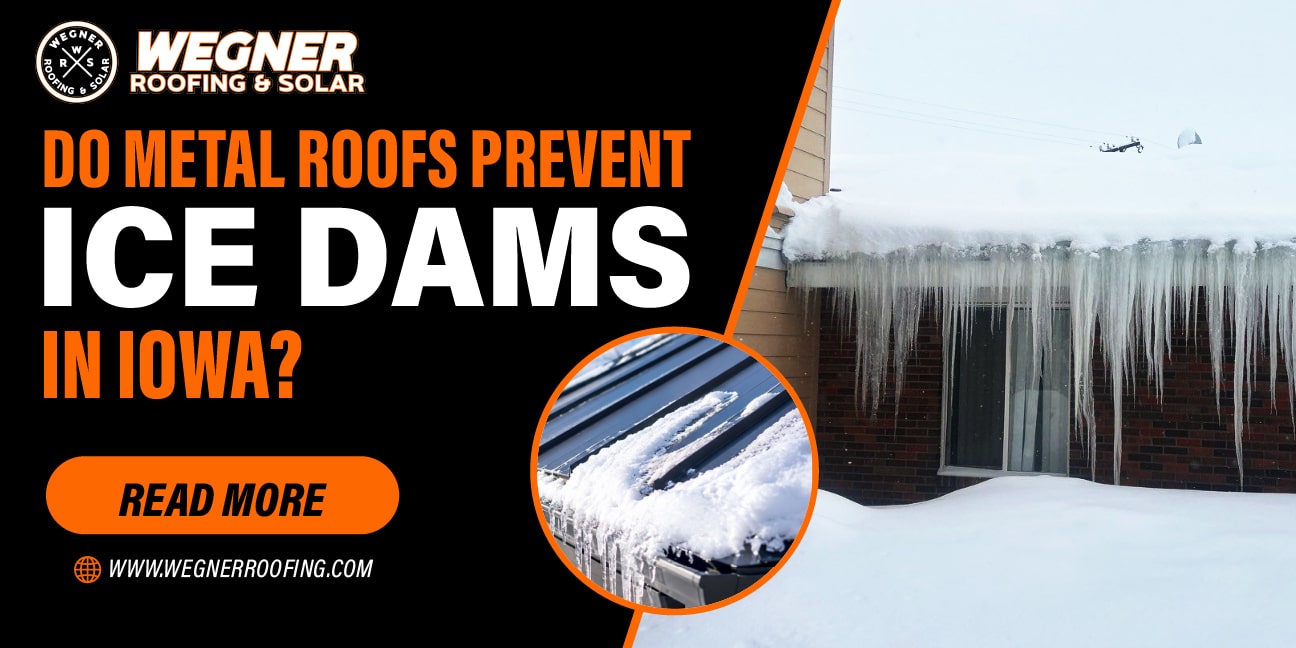
While metal roofs do see fewer ice dams than shingle roofs, the word ‘prevent’ isn’t entirely accurate.
A metal roof changes how ice forms on your home rather than eliminating the underlying conditions that cause it in the first place.
The real story involves attic heat, insulation levels, and snow behavior, factors that matter just as much as the roofing material itself.
If you’re weighing metal for your DeWitt home this winter, here’s the honest mechanical breakdown behind that decision, not a sales pitch.
What Actually Causes Ice Dams on a DeWitt Roof
Ice dams develop when indoor heat leaks into the attic, raising the roof’s temperature and melting the snow resting over the home’s heated areas.
That meltwater runs down and refreezes the moment it hits the cold, unheated overhang at the eave.
This is an attic and insulation problem first, not strictly a roofing-material problem.
That’s true whether the panels overhead are asphalt shingles or steel.
The typical sequence looks like this:
- Attic heat rises and warms the underside of the roof deck.
- Snow sitting over the heated section melts from below.
- Meltwater travels downslope toward the eave.
- The eave overhang stays cold because it’s unheated, so the water refreezes.
- Ice builds behind the dam, backing water up under the roofing material.
Why Snow Slides Off a Metal Roof in DeWitt, IA
Here’s where metal roofing changes the equation.
Snow effortlessly glides off metal roofs due to their sleek, low-friction finish, and because standing seam panels hide their fasteners, there is nothing for the snow to grip.
Instead of accumulating in layers like snow does on textured asphalt shingles, snow on a metal roof tends to:
- Slide off in sheets once temperatures rise slightly above freezing.
- Shed faster on steeper pitches common in DeWitt’s downtown and 6th Avenue neighborhoods.
- Leave less total snow mass sitting on the roof deck at any given time.
Less snow sitting on the roof means less total meltwater volume available to refreeze at the eave.
That’s the real reason metal roofs see fewer severe ice dam events, not because the metal itself resists ice.

Wegner Roofing & Solar has inspected both metal and shingle roofs across Clinton County long enough to see this pattern hold up winter after winter.
If you’re deciding which system fits your home, our Metal Roofing page walks through panel types, gauges, and finishes available in the DeWitt market.
Metal Roof vs. Shingle: Ice Dam Risk Compared
When comparing metal vs. shingle roofs for ice dams, the conversation isn’t really about which material is waterproof.
It’s about how each surface manages snow load and how each system tolerates the moisture that eventually finds its way underneath.
Factor | Metal Roof | Asphalt Shingle Roof |
Snow retention | Sheds quickly, less buildup | Granule texture holds snow longer |
Fastener exposure | Concealed on standing seam | None, but backed-up water seeps under overlaps |
Freeze-thaw cracking risk | Minimal; panels flex with temperature swings | Higher; shingles crack and lift over years |
Underlayment protection | Still required at eaves and valleys | Still required at eaves and valleys |
Both systems still need a properly installed ice and water shield membrane at the eaves.
Metal doesn’t remove that requirement; it just reduces how often the dam forms in the first place.
Where Ice Still Forms at the Metal Roof Eave
Even with faster snow shed, metal roof eave ice can still develop under specific conditions:
- Long stretches of sub-freezing days with no melt-refreeze cycle to clear accumulated snow.
- Poorly ventilated attics that keep warming the roof deck from below.
- Valleys, dormers, and areas where multiple roof slopes funnel snow into one section.
- North-facing slopes that stay shaded and colder than the rest of the roof.
The eave overhang itself is always the coldest part of any roof, metal or shingle, because it typically extends past the heated wall line of the house.
The Role of Attic Ventilation Under a Metal Panel System
Attic ventilation in metal roof systems matters just as much as it does under shingles.
Blocked soffit vents trap heat and moisture in the attic space, which keeps warming the underside of the deck regardless of what’s fastened on top.
For DeWitt’s climate zone, the U.S. Department of Energy recommends attic insulation between R-49 and R-60.
Homes below that threshold are more likely to see:
- Warmer attic air pooling near the ridge.
- Faster snowmelt over the insulated portion of the roof.
- A wider gap between the melt zone and the cold eave, which is exactly where ice dams build.
Ready to see how your attic and roof are performing together this winter? Schedule a free evaluation with Wegner Roofing & Solar before the next hard freeze settles in over Clinton County.
Do You Need Snow Guards on a Metal Roof in DeWitt?
Because metal sheds snow so efficiently, installing snow guards is a crucial conversation to have at the estimate stage, especially on homes where a roofline sits directly over:
- Walkways, driveways, or entry doors.
- Decks, patios, or outdoor living spaces.
- HVAC units, gas meters, or landscaping below the eave.
Snow guards don’t stop ice dams. They control when and how snow releases, preventing a sudden slide from becoming a safety hazard on a mild afternoon after a heavy DeWitt snowfall.
Key Takeaways
Escaping attic heat, not your choice of roofing material, is what actually creates ice dams. A metal roof just lowers your risk by clearing snow off the roof faster.
A metal roof snow slide lowers total snow mass on the roof, which limits how much meltwater can refreeze at the eave.
Attic ventilation and insulation still need to meet DeWitt’s R-49 to R-60 standard regardless of roofing material.
Snow guards are a safety consideration for metal roofs over walkways and entries, not an ice dam solution.
The Real Fix: Pairing Metal Panels with Smart Attic Design
A metal roof gives DeWitt homeowners a massive advantage against ice dams, but it’s only half the battle.
It must be paired with proper attic insulation, clear soffit vents, and correctly installed ice and water shield at the eaves.
Address the roof surface and the attic ventilation together, and you’ll solve the problem for good.
For a deeper look at how standing seam and other panel systems perform against Iowa winters, check out our DeWitt IA Metal Roofing Guide, and review our Roof Maintenance DeWitt IA Homeowner Checklist for a seasonal plan that keeps ice dams from forming in the first place.
Not sure if your current roof and attic setup are working against you this winter? Call Wegner Roofing & Solar today for a straight answer, not a sales pitch, on what’s really happening above your ceiling.

FAQs About Metal Roofs and Ice Dams in DeWitt, IA
Do metal roofs stop ice dams?
Metal roofs don’t fully stop ice dams, but they reduce risk by shedding snow faster than shingles, leaving less snowpack to melt and refreeze at the eave.
Because escaping heat from the attic is the true root cause, proper insulation and ventilation remain essential no matter what kind of roof you install.
Do metal roofs need snow guards?
Metal roofs often benefit from snow guards over walkways, driveways, decks, or entry doors, since panels shed snow in large, sudden sheets.
Snow guards control the release timing for safety; they don’t address ice dam formation itself.
Why does snow slide off a metal roof?
Snow slides off a metal roof because the panel surface is smooth and low-friction, especially on standing seam systems with no exposed fasteners.
Combined with steeper pitches, this prevents the layered snow buildup common on textured asphalt shingles.
Table of Contents
Do Metal Roofs Prevent Ice Dams in Iowa? Table of Contents If you live in DeWitt, IA, you know our Clinton County winters deliver dozens
Standing Seam vs. Corrugated Metal Roof Price Table of Contents If you’re comparing the cost of a standing seam vs. corrugated metal roof in DeWitt,
Drip Edge Installed Wrong on a DeWitt Roof? Signs, Damage, and Fixes Table of Contents DeWitt sits between the Wapsipinicon and Mississippi River valleys, where
Soft Spots on a DeWitt Roof: What Spongy Decking Means After Derecho Season Table of Contents DeWitt’s 2026 derecho season pushed straight-line winds through the
Loose Shingles After a DeWitt Windstorm: Why They Lift and What Repair Costs Table of Contents A gust rolls off the fields along Lincoln Highway